Utilities Can Accelerate Grid Modernization by Bridging IT/OT Architectural Divide, Advises Info-Tech Research Group
Canada NewsWire
ARLINGTON, Va., March 5, 2026
With grid modernization accelerating across the utilities sector, digital and operational systems are increasingly being interconnected to enable seamless operations. In many cases, enterprise architecture continues to sit within IT, leaving operational technology outside formal oversight and enterprise governance. New insights from Info-Tech Research Group, a global research and advisory firm, show how this structural divide constrains modernization progress. The firm's recently published blueprint, Extend Enterprise Architecture to Operational Technology for Utilities, outlines a phased methodology to help utilities unify IT and OT architecture, strengthen governance, and improve integration across grid systems.
ARLINGTON, Va., March 5, 2026 /CNW/ - Utilities are investing heavily in advanced metering infrastructure, distributed energy resource integration, and smart grid automation, yet these initiatives often move forward without unified architectural oversight. IT and operational technology environments typically follow different governance guidelines, lifecycle timelines, and design priorities, resulting in fragmented data flows and integration challenges. Newly published research from Info-Tech Research Group indicates that this structural misalignment increases integration complexity and limits modernization impact. The firm's Extend Enterprise Architecture to Operational Technology for Utilities blueprint provides industry leaders with a structured approach to embed OT within enterprise architecture practices and strengthen coordination across digital systems and grid operations.
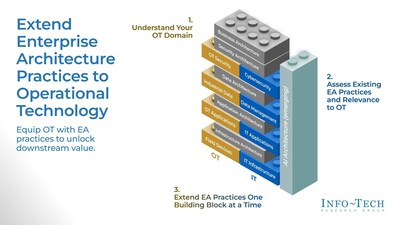
Enterprise architecture practices in utilities have historically been developed within IT, while operational technology systems such as SCADA, field networks, and grid control platforms evolved under separate operational mandates. IT assets are often refreshed on multi-year cycles with an emphasis on agility and scalability, whereas OT infrastructure may remain in place for decades, prioritizing reliability, safety, and real-time performance. These differing timelines and design philosophies reinforce organizational silos, making it difficult to establish shared standards for data, integration, security, and lifecycle planning. Without a coordinated architectural model spanning both domains, modernization investments can introduce additional complexity instead of operational cohesion.
"Utilities don't struggle with grid modernization because they lack technology," says Bevin Chau, Research Director at Info-Tech Research Group. "They struggle because IT and operational technology are governed separately. When OT sits outside enterprise architecture, integration decisions get made project by project instead of at the enterprise level, and that slows progress."
Key Challenges Slowing IT/OT Architectural Alignment in Utilities
Bringing IT and operational technology under a shared architectural model is rarely straightforward. Differences in accountability, investment cycles, and decision-making authority often sit beneath the surface of modernization programs. Info-Tech's blueprint highlights several recurring challenges that utilities must address to close the IT/OT divide:
- Conflicting Priorities: IT organizations are often driven by agility and cost optimization, while OT teams focus on system reliability and safety. Those priorities influence how architecture standards are defined and enforced.
- Uneven Lifecycles: Enterprise platforms may be upgraded within a few years, but grid and field systems can remain operational for decades. Coordinating planning across those timelines requires deliberate governance.
- Limited OT Representation in EA Processes: Enterprise architecture reviews frequently center on enterprise applications and cloud environments, with operational systems reviewed separately or not at all.
- Project-Led Integration Decisions: Modernization initiatives are commonly scoped independently, resulting in integration approaches that solve immediate needs but do not establish reusable architectural patterns.
Info-Tech's Phased Approach to Extending Enterprise Architecture Into OT
To help utilities move beyond siloed modernization efforts, Info-Tech's blueprint, Extend Enterprise Architecture to Operational Technology for Utilities, outlines a phased approach for incorporating operational technology into enterprise architecture practices. The process begins with understanding current OT capabilities, moves to assessing where architectural governance falls short, and concludes by applying those principles through a modernization example:
- Phase 1: Evaluate OT Capabilities and Context
Enterprise architects and OT leaders map operational capabilities to business objectives using a utilities-specific business reference architecture. This work highlights where OT directly supports compliance requirements, service reliability, and broader strategic goals. - Phase 2: Assess EA Applicability to OT
Organizations conduct a maturity assessment to determine how well enterprise architecture processes account for OT systems. The analysis surfaces gaps in standards, review processes, and lifecycle coordination. - Phase 3: Apply EA Practices Through an AMI Walkthrough
Using advanced metering infrastructure as a reference case, the blueprint walks through how architecture decisions shape integration, security, data governance, and infrastructure planning across both IT and OT environments. The example can be adapted to other modernization programs, including DER integration and grid automation initiatives.
By extending enterprise architecture into operational technology, utilities align digital investments with grid operations. Architectural decisions can then be evaluated across both domains rather than within isolated teams or project scopes. Over time, this alignment reduces integration friction and enables more deliberate lifecycle planning across systems that were previously managed independently.
Info-Tech's Extend Enterprise Architecture to Operational Technology for Utilities blueprint includes capability mapping guidance, a maturity assessment and gap analysis tool, and a roadmap framework to help utilities prioritize architectural alignment across IT and OT. By applying the firm's insights, utilities can shift from siloed modernization efforts to a coordinated architectural model that strengthens grid reliability and supports sustained digital transformation.
For exclusive and timely commentary from Info-Tech's experts, including Bevin Chau, and full access to the Extend Enterprise Architecture to Operational Technology for Utilities blueprint, please contact pr@infotech.com.
About Info-Tech Research Group
Info-Tech Research Group is one of the world's leading and fastest-growing research and advisory firms, serving over 30,000 IT, HR, and marketing professionals around the globe. As a trusted product and service leader, the company delivers unbiased, highly relevant research and industry-leading advisory support to help leaders make strategic, timely, and well-informed decisions. For nearly 30 years, Info-Tech has partnered closely with teams to provide everything they need, from actionable tools to expert guidance, ensuring they deliver measurable results for their organizations.
To learn more about Info-Tech's HR research and advisory services, visit McLean & Company, and for data-driven software buying insights and vendor evaluations, visit the firm's SoftwareReviews platform.
Media professionals can register for unrestricted access to research across IT, HR, and software, and hundreds of industry analysts through the firm's Media Insiders program. To gain access, contact pr@infotech.com.
For information about Info-Tech Research Group or to access the latest research, visit infotech.com and connect via LinkedIn and X.

 View original content to download multimedia:https://www.prnewswire.com/news-releases/utilities-can-accelerate-grid-modernization-by-bridging-itot-architectural-divide-advises-info-tech-research-group-302705818.html
SOURCE Info-Tech Research Group

